Showing posts with label feedback. Show all posts

Saturday, 19 March 2016

Tools and ideas

Voice typing with Google Docs

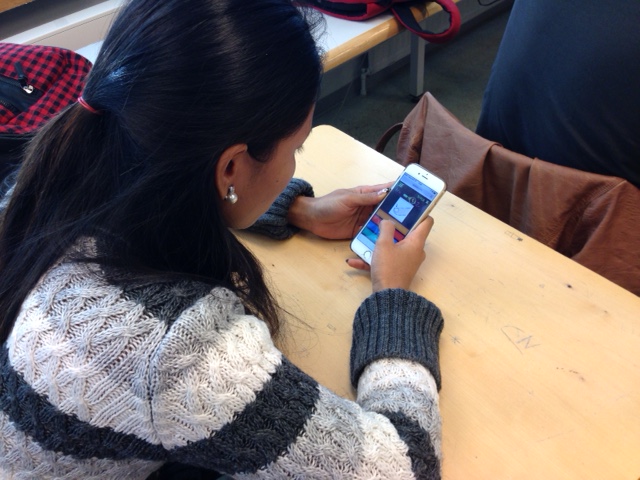
It really is great that Google has this feature. How to use it in language learning? The first thing that came to my mind was to help students check their pronunciation and get immediate feedback on it with the help of voice typing. What we did was pretty simple. The students had a text in the target language, which in our case is Finnish. They read the text and observed if it was similar to the original one. They often wanted to try several times to make the pronunciation match with the text. The feedback is instant, which is great. It's also really easy for them to practise pronunciation this way at home. 

Do you have any other ideas? 

For those readers who are not familiar with voice typing, check this posting by Alice Keeler.

Quizizz

When I heard about Quizizz, I was curious to see what it has to offer in comparison with, for example, Kahoot and Socrative which my students really like. Turns out Quizizz also offers a homework option. The gaming factor is also there, but instead of time pressure, the students can now do the quiz in peace and quiet with the help of any material they can think of. Highly recommended!

Google Slides

Better late than never! I have only recently discovered the wonderland of Google Slides for language learning classes. What a great way to collaborate, differentiate, learn together and so much more!
Presently my students are practising the use of past tense both in affirmative and negative sentences in Finnish. For revision I created a presentation with each slide containing only two sentences: the first one being affirmative and the second one negative, which appears with a click. The students worked in pairs and took turns in reading the affirmative sentences and then trying to form the negative ones and then checking with a click if they got it right. It worked really well and the students got a lot of practise! Simple and useful! 

I was pleased to find a lot of information both in Finnish and English on how to use Google Slides in the classroom. I very much like the idea of creating a presentation and giving each group a slide number to work, and there are so many other cool ways to use this tool. To read about them, here's a link to a crowd sourced presentation initiated by Alice Keeler and Hans Tullmann.

 
Quizizz in the classroom

Quizizz in the classroom


Practice makes perfect

Tuesday, 4 November 2014

Three iPad apps for language learning classroom

It's been a busy autumn with my new group. The students have already improved their Finnish skills quite a bit and they have  also started a course in mathematics. There will be more school subjects coming as their language skills develop. 

This time I'm going to present a few more iPad apps that I have used with my students to encourage them to practise their pronunciation, speaking and listening skills:

The app is designed for decision making but it turns out there are so many other ways to use it. My students, who are presently at beginners’ level in their language studies, have been using it for practising question formation, followed by discussion: Just add question words in the wheel and voilà, you’ll have a wheel that can be used in various contexts. Decide Now! is also a handy tool for practising vocabulary: Write the words in the wheel, students can then form sentences using them, define them or create a dialogue around them. Fun and effective, and when students work in pairs each one of them gets a lot of practice!


Pronunciation can be tricky. I am a supporter of each student’s own personal accent but I also encourage them to learn pronunciation to avoid misunderstandings simply because in the real world they need to be understood. I listen to my students speaking a lot, they also read aloud to me from time to time. I encourage them to use online dictionaries with audio as well as listen to the language around them. Yet another way to practise pronunciation is with Dragon Dictation. It is a voice recognition application. My students have used it, for example, for reading aloud short dialogues. Then they check the writing and see if there’s something to be corrected. In this way they also practise reading and spelling. The app can also be used for reading out easily confused words. For example, many Finnish language learners find it challenging to recognize between long and short vowels (tuli – tuuli) and double consonants (kuka – kukka).


So far we've only tried this app once, so there are yet many things to explore. The students were given a situation and they created a dialogue. The students then recorded the dialogue and later we listened to each one of them. A quick and easy way to practise speaking and listening skills. The students also like the idea of re-recording the dialogue if they were not happy with the final result.

Friday, 15 August 2014

Part I: One step towards going paperless - Studying a course without the traditional course book

Part I: Some highlights from the previous school year

I wanted to try something different with my students. So I asked them how they’d feel about the idea of studying the course without a course book, and their response was positive. I’d taught this course several times before, therefore I was pretty familiar with the contents and objectives outlined in the curriculum and felt quite confident in saying goodbye to the course book for a while. Our course was called ENA7 Nature and Sustainable Development, and we used Google Sites to complete the project.

We had access to computers as well as iPads so I wanted to make use of them. The project for the students was to create their own website on a course-related topic. They needed to do some background studying, learn new vocabulary, find suitable photos and videos or create them by themselves. To make their sites more reader-friendly, they also created a glossary on essential vocabulary and added some questions for their peers to comment on.

As we know, a picture is worth a thousand words, so here are some photos of their work (they kindly gave me the permission to publish them here).

This is the home page with the students' topics on the left-hand margin.

An example of one site (a part of it)


Some students used word clouds to create illustration for the site.

An example of a glossary

Some questions for the fellow-students

I was really pleased to see the intensity of their studying. The students seemed to read more and with more enthusiasm than what they normally did with the course book (which, by the way, is awesome, too!).

Summa summarum, these were the benefits in my view:
  • Apart from a few texts I chose for all the students to study, they chose the majority of their own reading. This gave them an opportunity to critically evaluate the information offered. 
  • Being able to choose the topic for their project gave them a sense of ownership of their own learning. It was great to watch them work with their topics with such motivation. Everybody didn’t have to do exactly the same thing. I really liked the fact that the students could find the topics (within the course theme) that they found interesting. The learning process started from their own interests, and it was not something that the teacher decided for them.
  • They were in total control of their own websites and they could make them look as they wanted to. Again: ownership of their own learning.
  • Some of them wanted me to take a look at their texts before publishing them, this was easily done by sharing their work with me on Google Docs.
  • Later they studied the other students’ projects and gave feedback on them. I think it was important for them to get feedback from their peers. Since this was already their seventh course, they had had plenty of practice with this.
  • In case any of my Finnish colleagues are interested in knowing how the evaluation worked, this is how we did it: the project (100 points), the listening comprehension test (a previous year’s national exam 90 p.), vocabulary and grammar exercises and additional reading (110p.). So the students could gain max. 300 points of the whole course and those points were then turned into a school grade as usual.
Some other observations:
  • Young students seem to be using their smartphones and iPads a lot for entertaining purposes. However, I think many still need guidance and advice on how to use their devices for learning. There are some many possibilities for that!
  • I can’t put enough emphasis on copyright issues. As mentioned before, this was already our seventh course together, and I had started to talk about copyrights already from course one. For some reason, this theme needs to be covered again and again.
  • Sometimes it can get frustrating when the machines are not working. For example, the iPads seemed to have a mind of their own. Sometimes the reception was good and they worked well, but sometimes they didn't.

The technological side of things: 
  • We created the website with Google Sites. This worked out fine since my students have Google accounts from our school.  Google Sites also allowed students to comment on their projects. 
  • Some students used an iPad app called Tag Cloud to create word clouds for the website.
  •  Some students tried using an iPad app called Morfo for creating a video with audio (this was so much fun!).
  • To ensure theme-related vocabulary practice I created some Quizlet vocabularies which were a compulsory part of the course.  My students are pretty familiar with Quizlet and most of them create their own sets. How great is that!


  • Our school uses online platform called Fronter where I had prepared some grammar and vocabulary tests for my students. I created a course room on Fronter (this is how they are called) with the link to our website and to all other exercises. So this was the place where all the course information and assignments were gathered.